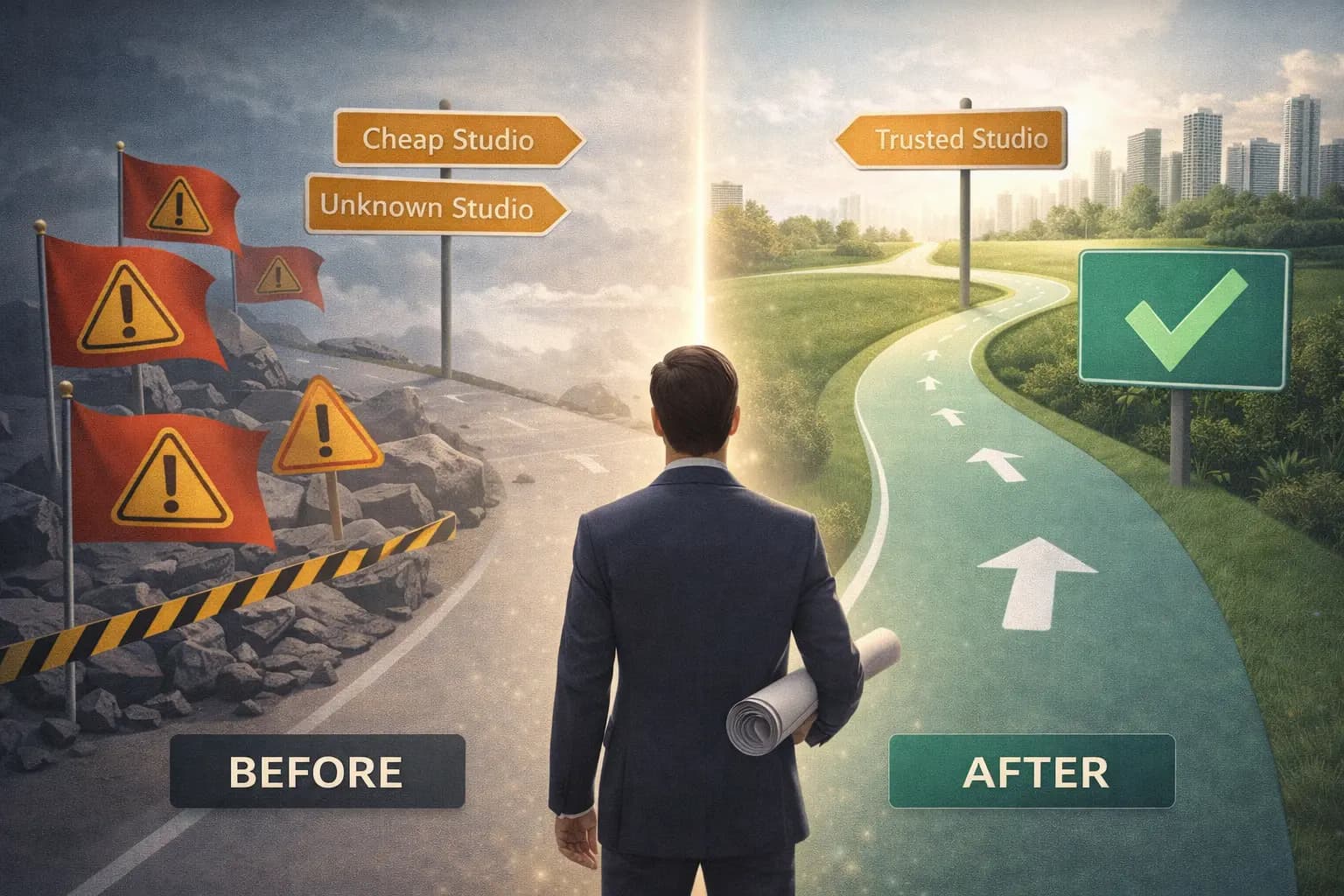
10 Critical Mistakes Developers Make When Hiring 3D Visualization Studios (And How to Avoid Them)
You've made the smart decision to invest in professional 3D architectural visualization for your real estate project. You understand that high-quality renderings accelerate sales, command higher prices, and provide tremendous ROI. You've allocated a budget, set timelines, and started researching potential studios.
But here's where many developers in Pakistan stumble. Between the initial decision to invest in visualization and actually receiving stunning renders that elevate your marketing, lies a minefield of potential mistakes that can derail your project, waste your budget, and cause costly delays.
The consequences of hiring the wrong 3D visualization partner extend far beyond just disappointing visuals. Poor-quality renderings damage your brand reputation, confuse buyers, delay launches, require expensive rework, and ultimately cost you sales. In Pakistan's competitive real estate market where DHA Karachi projects compete with Bahria Town Lahore developments and Capitol Smart City Islamabad launches, subpar visualization is a luxury you cannot afford.
This comprehensive guide exposes the ten most critical mistakes developers make when hiring architectural visualization studios, mistakes that separate successful projects from failed ones, happy clients from frustrated ones, and smart investments from wasted money. More importantly, we'll show you exactly how to avoid each pitfall and ensure you partner with a visualization studio that delivers exceptional results on time, on budget, and aligned with your vision.
Whether you're commissioning your first rendering or your fiftieth, these insights will save you time, money, and headaches while maximizing the return on your visualization investment.
Mistake #1: Choosing Based Solely on Price (The "Cheapest Option" Trap)
The single most common and costly mistake developers make is selecting visualization studios based purely on the lowest quote. When you receive proposals ranging from PKR 15,000 to PKR 80,000 for seemingly similar exterior renderings, the temptation to choose the cheapest option feels irresistible, especially when managing tight project budgets.
Why This Backfires Spectacularly
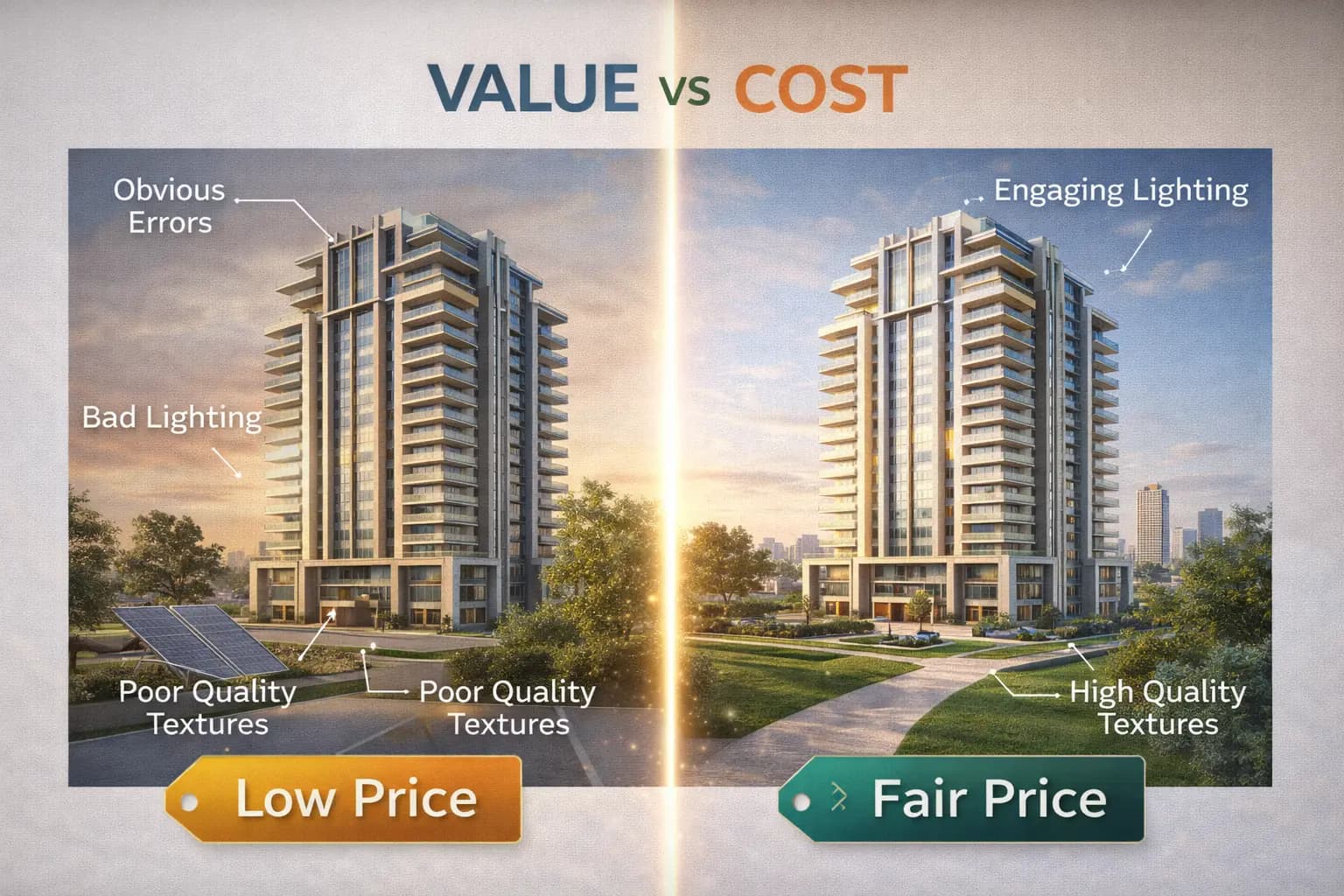
Price-driven decisions almost always result in disappointment. Rock-bottom pricing signals fundamental problems that will surface during your project. Ultra-low quotes typically indicate inexperienced artists learning their craft on your project, outsourcing to the absolute lowest-cost providers with minimal quality control, use of outdated software and techniques producing amateur results, inability to understand architectural nuances and design intent, or hidden costs that emerge later through excessive revision fees.
Consider this real scenario: A Lahore developer saved PKR 100,000 by choosing a budget studio for a luxury residential project. The resulting renderings looked amateurish, unrealistic lighting, poor proportions, obviously fake materials. The developer had to scrap the work entirely and commission a professional studio, ultimately spending PKR 250,000 total, 150% more than the original professional quote, while delaying the project launch by six weeks.
The True Cost of Cheap Visualization
When you hire cheap studios, you don't actually save money, you simply postpone and multiply expenses. Budget renderings typically require extensive revisions that quickly exceed any initial savings. You may need to completely redo visualization work with qualified professionals. Marketing materials featuring poor-quality renders damage brand perception. Sales teams struggle to convince buyers with unconvincing visuals. Project launches get delayed while waiting for acceptable renders. Most painfully, potential sales are lost because buyers cannot visualize the property effectively.
How to Evaluate Value, Not Just Price
Smart developers focus on value rather than cost. Value considers quality, reliability, expertise, and results, not just the invoice amount. When evaluating quotes, examine portfolio quality critically, do samples demonstrate photorealism or obviously look like computer graphics? Calculate total cost including likely revisions, a PKR 50,000 quote with three included revision rounds often costs less than a PKR 30,000 quote charging PKR 15,000 per revision. Consider timeline reliability, delayed visualization pushes back your entire project schedule, creating opportunity costs far exceeding any upfront savings.
Ask yourself: if this rendering influences a PKR 2 crore property sale, is saving PKR 30,000 on visualization worth risking the entire transaction? Absolutely not. When stakes are high, professional quality is the only acceptable standard.
The Pricing Sweet Spot
In Pakistan's market, professional architectural visualization falls within predictable ranges. For standard residential projects, expect to invest PKR 40,000-90,000 for quality exterior renderings, PKR 45,000-100,000 for detailed interior visualizations, PKR 150,000-400,000 for comprehensive virtual tours, and PKR 300,000-800,000 for cinematic animation packages. These ranges reflect fair pricing for professional work using modern technology, experienced artists, and reliable project management.
Quotes significantly below these ranges should trigger serious skepticism. Ask detailed questions about why pricing is lower, perhaps the studio genuinely has lower overhead or is building their portfolio, both legitimate reasons. But if you receive vague answers or pricing that seems too good to be true, trust your instincts and look elsewhere.
Remember: in 3D visualization, you get exactly what you pay for. Invest wisely.
Mistake #2: Skipping Portfolio Reviews (Or Reviewing Them Superficially)
Many developers give portfolio reviews cursory attention, quickly scrolling through a studio's website, seeing a few decent images, and assuming competence. This superficial evaluation is a critical error that often leads to hiring mismatched partners.
What Portfolio Reviews Actually Reveal
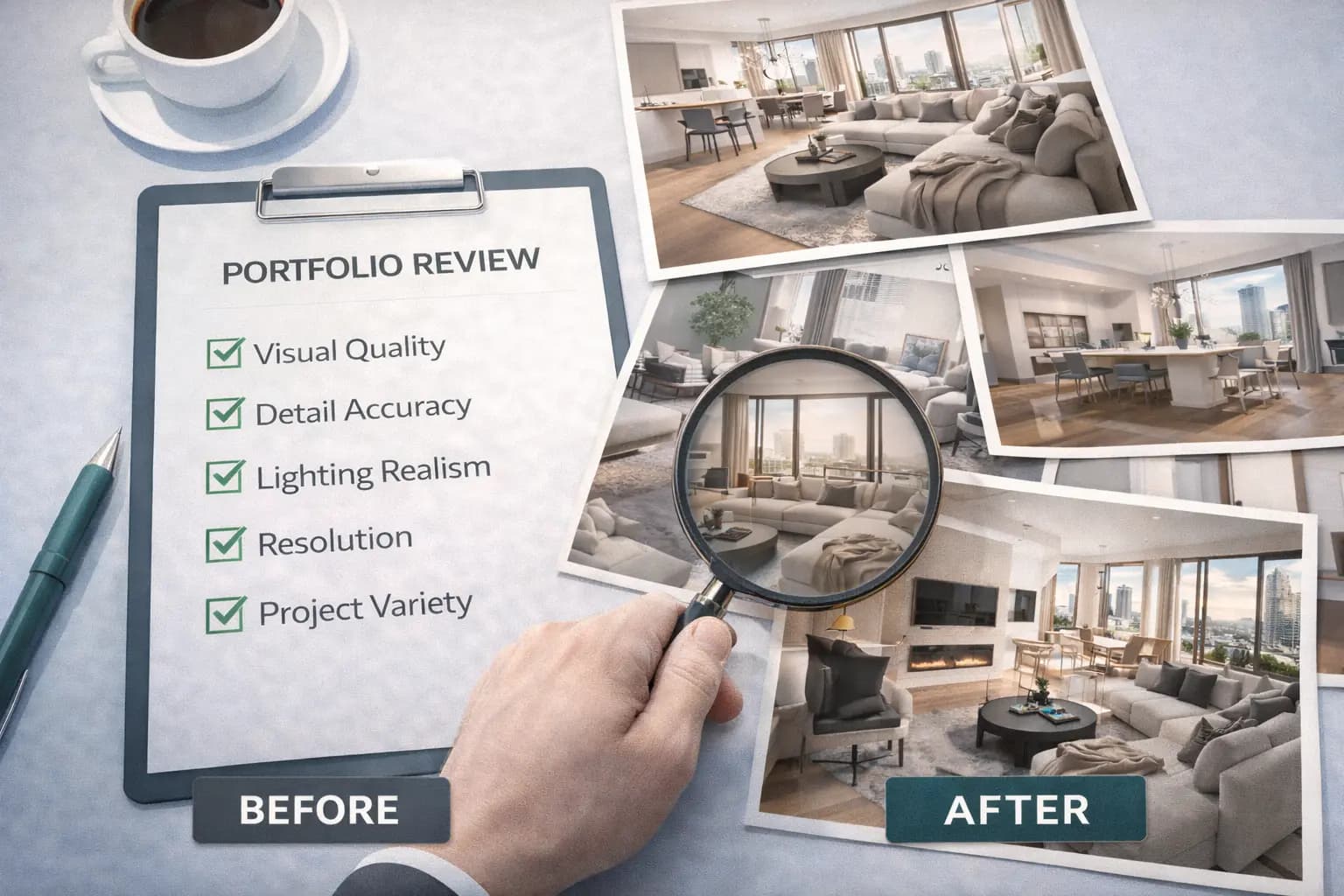
A comprehensive portfolio review tells you far more than just whether a studio can create pretty pictures. Portfolios reveal technical capability (lighting, materials, composition), specialized experience in your project type (residential, commercial, luxury, mid-range), stylistic alignment with your vision (photorealistic vs. stylized, modern vs. traditional), attention to architectural detail and accuracy, understanding of environmental context and landscaping, ability to convey spatial relationships effectively, and consistency across multiple projects.
Consider this real scenario: A Lahore developer saved PKR 100,000 by choosing a budget studio for a luxury residential project. The resulting renderings looked amateurish, unrealistic lighting, poor proportions, obviously fake materials. The developer had to scrap the work entirely and commission a professional studio, ultimately spending PKR 250,000 total, 150% more than the original professional quote, while delaying the project launch by six weeks.
View our Case Studies and Portfolio
How to Review Portfolios Properly
Don't just glance, analyze critically. Look for specific indicators of quality and expertise. Examine lighting realism, do renders show natural light behavior with proper shadows, reflections, and ambient occlusion? Or does lighting look flat and artificial? Assess material authenticity, do textures like wood, concrete, glass, and fabric look convincing or obviously computer-generated? Evaluate architectural accuracy, do proportions, scales, and spatial relationships feel correct? Notice environmental integration, are buildings placed in believable contexts with appropriate landscaping, surrounding structures, and atmospheric effects?
Study composition and framing, are camera angles chosen to showcase architecture effectively? Look at people and vehicles, do they appear natural or awkwardly placed? Check for technical errors, floating objects, intersecting geometry, perspective distortions, or unrealistic reflections indicate inexperience.
Critical Portfolio Red Flags
Certain portfolio characteristics should immediately raise concerns. If a studio shows only two to three sample projects, question their experience depth. Inconsistent quality across portfolio pieces suggests unreliable delivery, sometimes excellent, sometimes poor. Outdated or low-resolution samples indicate they're not keeping pace with industry standards. Overuse of obviously stock models and generic furniture signals lack of customization capability. Most concerning is borrowed or stolen work, unfortunately, some unscrupulous providers showcase others' renderings as their own.
Portfolio Questions to Ask
Don't assume portfolio pieces tell the complete story. Ask studios directly: "Are all portfolio samples your own original work?" "Which team members worked on the projects most similar to mine?" "Can you show me samples specifically from Pakistan-based residential/commercial projects?" "What was the timeline and budget for your strongest portfolio pieces?" "Can you provide client references for projects similar to mine?"
These questions expose inconsistencies and verify expertise. A legitimate studio welcomes detailed portfolio discussions. Evasive answers or reluctance to provide references should concern you.
Matching Portfolio Style to Your Needs
Even high-quality portfolios can be wrong for your specific project. A studio specializing in ultra-modern luxury villas might struggle with traditional Pakistani architectural styles. One excelling at small residential projects may lack experience visualizing large mixed-use developments. Review portfolios specifically for examples matching your project type, scale, architectural style, target market, and intended use (marketing, approvals, investor presentations).
If a studio's portfolio doesn't include work similar to yours, ask why and whether they're confident handling your requirements. Consider requesting a small paid test rendering before committing to comprehensive packages.
Contact us now!
Mistake #3: Failing to Provide Complete Project Information (The Incomplete Brief)
Imagine commissioning a custom suit from a tailor but only providing your waist measurement, no chest size, inseam, shoulder width, or style preferences. The tailor would have to guess, and the result would fit poorly. Yet developers routinely make this exact mistake with 3D visualization, providing minimal information and expecting studios to fill gaps with assumptions.
Why Incomplete Briefs Guarantee Disappointment
3D visualization is not telepathy. Artists cannot read your mind or intuitively know your unstated preferences. When you provide only basic floor plans without material specifications, lighting preferences, or style references, visualization teams must make hundreds of creative decisions independently, decisions that might not align with your vision.
The consequences are predictable. Renderings don't match your expectations, requiring extensive and expensive revisions. Project timelines extend as studios await clarifications. Frustration builds on both sides as miscommunication creates conflict. Worst of all, final deliverables may still fall short because the foundation, your brief, was fundamentally inadequate.
View our Case Studies and Portfolio
The Anatomy of a Complete Visualization Brief
Professional visualization requires comprehensive information across multiple categories. Provide complete architectural documentation including detailed floor plans, elevations, sections, site plans, and any existing 3D models or CAD files. Share material and finish specifications, exactly which flooring materials, wall finishes, ceiling treatments, window systems, and exterior cladding you want depicted. Describe lighting scenarios, daytime with natural light, golden hour with warm sunset tones, evening with interior lighting, or night with dramatic architectural lighting.
Offer style and aesthetic references. Create a mood board with reference images showing desired visual tone, modern minimalist, traditional Pakistani, luxury contemporary, or any other aesthetic direction. Specify environmental context details, what surrounds the property? Neighboring buildings, landscapes, street furniture, vehicles, people? Include brand guidelines if applicable, color palettes, fonts, logo usage, or any corporate identity elements that should influence visualization.
Clarify marketing objectives and target audience. Are you attracting luxury buyers, middle-income families, international investors, or commercial tenants? Each audience responds to different visual approaches. Define intended usage, website images, social media posts, billboards, brochures, investor presentations? Different channels require different formats and compositions.
Specify technical requirements including desired output resolution, file formats needed, how many revision rounds you expect, and absolute deadline constraints.
Critical Portfolio Red Flags
Certain portfolio characteristics should immediately raise concerns. If a studio shows only two to three sample projects, question their experience depth. Inconsistent quality across portfolio pieces suggests unreliable delivery, sometimes excellent, sometimes poor. Outdated or low-resolution samples indicate they're not keeping pace with industry standards. Overuse of obviously stock models and generic furniture signals lack of customization capability. Most concerning is borrowed or stolen work, unfortunately, some unscrupulous providers showcase others' renderings as their own.
Portfolio Questions to Ask
Don't assume portfolio pieces tell the complete story. Ask studios directly: "Are all portfolio samples your own original work?" "Which team members worked on the projects most similar to mine?" "Can you show me samples specifically from Pakistan-based residential/commercial projects?" "What was the timeline and budget for your strongest portfolio pieces?" "Can you provide client references for projects similar to mine?"
These questions expose inconsistencies and verify expertise. A legitimate studio welcomes detailed portfolio discussions. Evasive answers or reluctance to provide references should concern you.
Matching Portfolio Style to Your Needs
Even high-quality portfolios can be wrong for your specific project. A studio specializing in ultra-modern luxury villas might struggle with traditional Pakistani architectural styles. One excelling at small residential projects may lack experience visualizing large mixed-use developments. Review portfolios specifically for examples matching your project type, scale, architectural style, target market, and intended use (marketing, approvals, investor presentations).
If a studio's portfolio doesn't include work similar to yours, ask why and whether they're confident handling your requirements. Consider requesting a small paid test rendering before committing to comprehensive packages.
Contact Us Now!
Mistake #4: Ignoring Communication Quality During Initial Interactions
The sales process reveals how studios will perform during actual project execution. If communication feels difficult, unclear, or frustrating before you've even hired them, expect those problems to multiply dramatically once work begins. Yet developers often excuse poor pre-sales communication, assuming things will improve, they rarely do.
Communication Red Flags in the Sales Process
Pay close attention to how studios handle early interactions. Delayed responses (taking three to five days to reply to straightforward inquiries) signal either disorganization or lack of interest, both problematic. Vague answers to specific questions suggest they're hiding capabilities or lack expertise. Difficulty understanding your requirements reveals language barriers or insufficient architectural knowledge. Absence of clarifying questions means they're not fully engaged with your project's unique needs.
Unwillingness to discuss process details transparently indicates something to hide. Pressure tactics to commit quickly without adequate information show more concern for closing sales than ensuring fit. Each red flag increases the likelihood of a frustrating project experience.
What Good Communication Looks Like
Professional visualization studios demonstrate communication excellence from first contact. Responses arrive within 24 hours for initial inquiries and within a few hours for active project questions. Answers address your questions directly and comprehensively rather than providing generic responses. They ask thoughtful clarifying questions to fully understand requirements. Explanations of technical concepts are clear and jargon-free. Project managers provide single points of contact rather than passing you between multiple people. All commitments and agreements are documented in writing.
Studios using project management platforms or CRM systems demonstrate organizational maturity. Regular update schedules keep you informed of progress without requiring constant check-ins.
Testing Communication Before Committing
Before signing contracts, test how studios handle communication challenges. Ask detailed technical questions about their process, software, revision policies, and timeline management. Request clarification on quote details or deliverables. Propose a hypothetical scenario like "What if I need to change architectural designs midway through the project?" and see how thoughtfully they respond.
Professional studios welcome detailed questions, it demonstrates your seriousness and helps ensure mutual understanding. Defensive or evasive responses to legitimate inquiries signal problems ahead.
Language and Cultural Alignment
For Pakistan-based projects, working with local studios offers communication advantages including shared language (Urdu/English), understanding of local architectural styles and buyer preferences, same time zone for real-time discussions, and familiarity with Pakistan's real estate market dynamics. International studios may offer certain capabilities but often struggle with cultural nuances and communication delays.
Ensure whoever you hire can communicate clearly in your preferred language without misunderstandings that lead to expensive errors.
Structured Communication Protocols
Before projects begin, establish clear communication protocols. Agree on preferred communication channels, email for documentation, WhatsApp for quick questions, scheduled video calls for detailed reviews. Define response time expectations for different types of communications. Set regular update schedules, perhaps weekly progress reports with preview images. Identify single points of contact on both sides to prevent confusion.
Clear protocols prevent the communication chaos that derails projects.
Contact Us Now!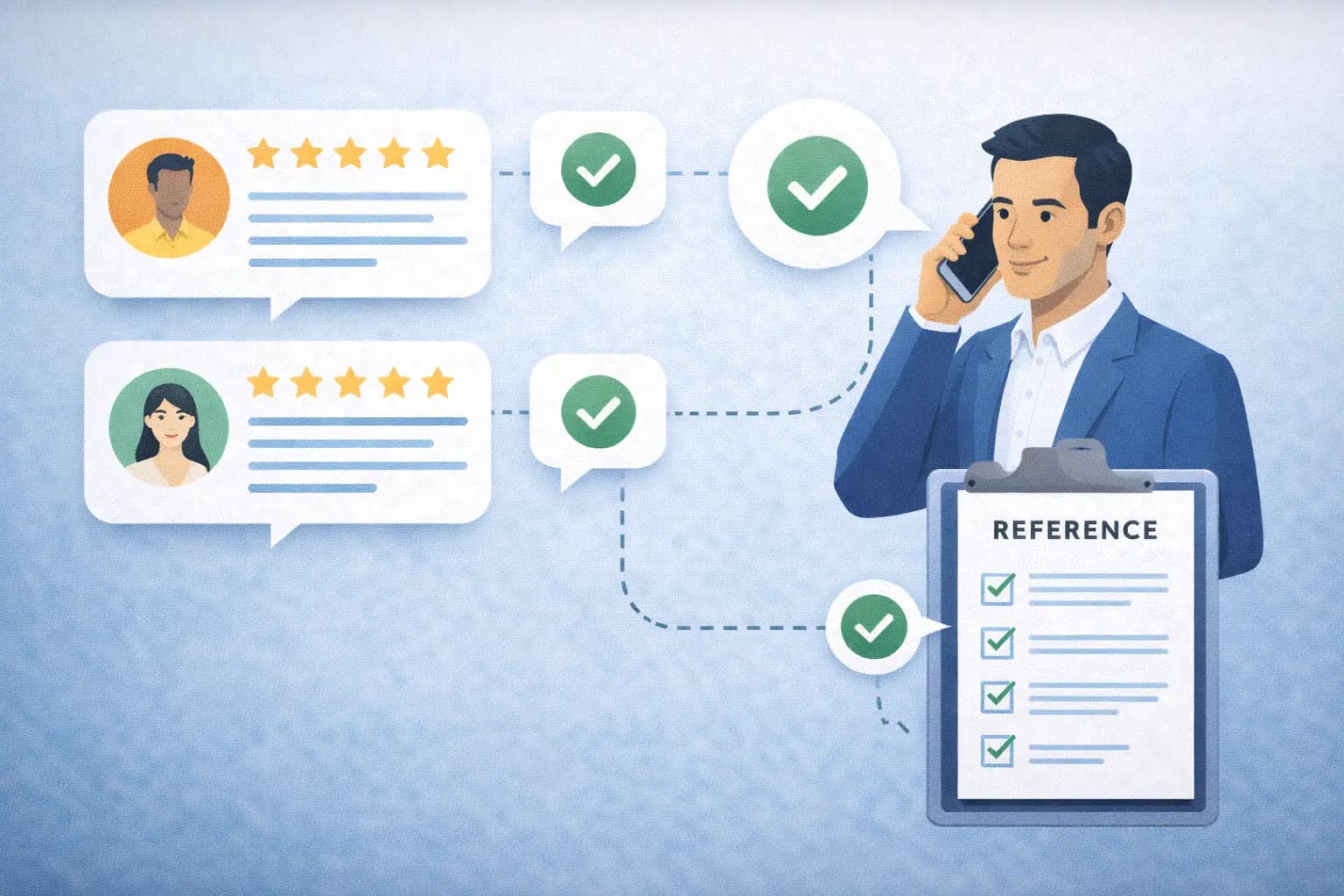
Mistake #5: Not Checking References and Client Testimonials
Portfolios show what studios can create. References reveal what actually working with them feels like. Skipping reference checks is like buying a car based solely on photographs without test driving it or reading owner reviews, you miss critical insights that dramatically affect your experience.
Why Developers Skip References
Reference checking feels time-consuming and awkward. Many developers assume positive online reviews suffice or that portfolios tell the whole story. Some fear offending studios by requesting references, worried it signals distrust. Others simply forget this crucial step in their rush to start projects.
These rationalizations lead to preventable disasters. Online reviews can be manipulated or fake. Portfolios don't reveal deadline reliability, communication quality, revision handling, or problem-solving capabilities under pressure. And professional studios expect reference requests, it's standard business practice, not an insult.
What References Actually Tell You
Speaking with studios' previous clients provides invaluable information portfolios cannot convey. You learn about deadline adherence, were projects delivered on time, late, or early? Revision handling, how did studios manage change requests, corrections, and adjustments? Communication quality during active projects, were updates regular and informative? Problem-solving ability, when issues arose, how creatively and professionally were they resolved?
References also reveal budget reliability (were there surprise fees or costs beyond quoted amounts?), professionalism under pressure (did they remain courteous and solution-oriented during stressful situations?), and long-term satisfaction (would previous clients work with this studio again? Have they?).
How to Conduct Effective Reference Checks
Don't just verify that references exist, actually call or email them with specific questions. Request at least three references for projects similar in scale and type to yours. Ask focused questions: "Was the project completed within original timeline and budget?" "How many revision rounds were needed before achieving satisfactory results?" "How would you rate communication and responsiveness throughout the project?" "Did any problems arise, and if so, how were they handled?" "Would you hire this studio again for future projects?" "Is there anything you wish you'd known before working with them?"
Listen carefully to answers. Enthusiastic recommendations carry more weight than lukewarm endorsements. Hesitations or diplomatic phrasing like "They were fine" or "It worked out eventually" often signal unspoken problems.
Red Flags in References
Certain reference responses should concern you deeply. If a studio refuses to provide references entirely, question why previous clients won't vouch for them. Generic testimonials without specific project details may be fabricated. References who don't remember working with the studio or give vague answers suggest fake references. Complaints about communication, timelines, or surprise costs from multiple references indicate systemic problems.
Pay attention to what references don't say as much as what they do. If no one mentions meeting deadlines, quality likely came at the expense of speed. If communication isn't praised, it was probably frustrating.
Beyond Direct References: Research Independently
Supplement provided references with independent research. Search for studio names in online forums, social media, and real estate developer communities in Pakistan. Look for Trustpilot, Google, or Facebook reviews from broader client bases. Check if studios have worked with major, reputable developers, established companies typically vet partners carefully. Review their social media engagement and responsiveness to comments or inquiries.
The more sources confirming quality and professionalism, the safer your choice.
Building Your Own Reference Network
As you grow as a developer, build relationships with peers who've used visualization services. Informal recommendations from trusted colleagues within Pakistan's real estate community often prove more reliable than anything a studio provides directly. Word-of-mouth reputation matters immensely in tight-knit markets.
Don't hire in isolation, leverage collective industry knowledge to avoid costly mistakes.
Contact Us Now!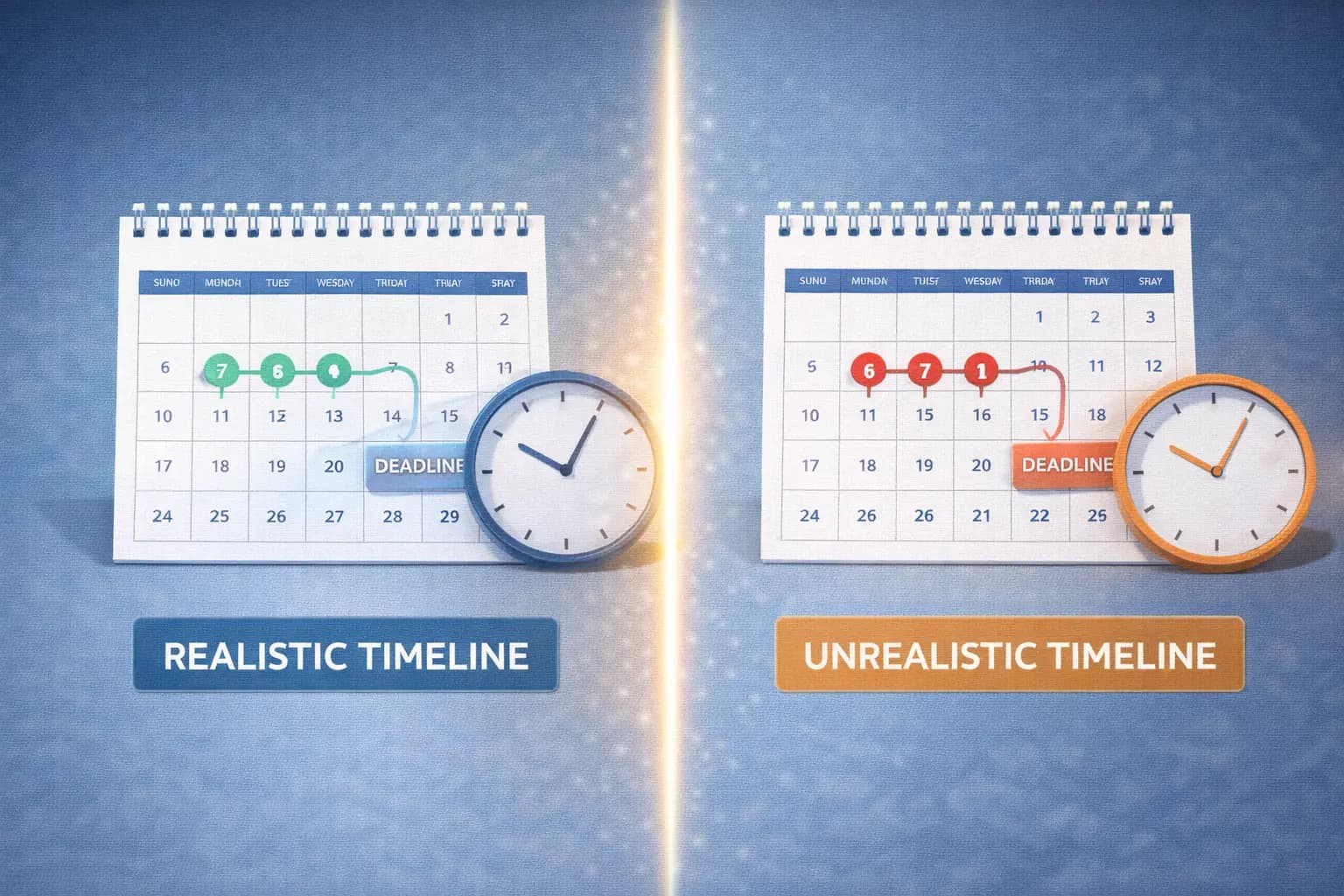
Mistake #6: Unrealistic Timeline Expectations (Rushing the Process)
Quality 3D visualization requires time. Photorealistic renders don't emerge from computers instantly like photographs from cameras. They require meticulous modeling, texturing, lighting setup, test rendering, adjustments, and final production processes that simply cannot be rushed beyond certain limits without destroying quality.
Yet developers routinely demand impossible timelines, then wonder why results disappoint.
The Complexity Behind the Renders
Understanding what goes into professional visualization helps set realistic expectations. For a single exterior rendering, artists must first create accurate 3D models from architectural plans, buildings, landscaping, and surrounding context. They then apply materials and textures to every surface, matching real-world properties of glass, concrete, wood, metal, fabric, and vegetation. Lighting is programmed to simulate natural or artificial light with physically accurate behavior.
The scene is composed with proper camera angles and framing. Initial test renders identify issues requiring adjustment. Multiple iterations refine lighting, materials, and composition until achieving photorealism. Final high-resolution rendering can take hours or days depending on scene complexity. Post-production enhances images with color correction, atmospheric effects, and compositing.
This process takes days per image for experienced professionals, longer for complex projects or inexperienced artists. Comprehensive packages with multiple views, virtual tours, or animations extend timelines to weeks or months.
Standard Timeline Expectations in Pakistan
For typical projects, professional studios in Pakistan deliver static exterior or interior renderings in five to seven business days, 3D floor plans in three to five business days, basic virtual tours with five to eight panorama nodes in two to three weeks, comprehensive virtual tours with 15+ nodes in three to four weeks, short walkthrough animations (30–60 seconds) in three to four weeks, and full cinematic animations (90–120 seconds) in four to six weeks.
These timelines assume you provide complete project information upfront and limit revision requests to reasonable adjustments within original scope. Incomplete briefs or extensive design changes extend timelines significantly.
The Cost of Rushing
When you demand delivery in 24–48 hours instead of standard five to seven days, quality suffers dramatically. Rush projects force studios to cut corners, simplified modeling, generic materials, minimal lighting refinement, less detailed environments, and abbreviated revision cycles. Artists work overtime with reduced attention to detail. Test renders and quality control steps get skipped.
The resulting renders look hasty, unconvincing, and unprofessional, exactly what you hoped to avoid by investing in visualization in the first place.
If you absolutely must have express delivery, expect to pay premium rush fees (typically 30–50% additional cost) and accept either reduced scope or quality compromises. Professional studios can prioritize your project, but physics and craftsmanship cannot be cheated, excellence takes time.
Planning Timelines Strategically
Smart developers incorporate visualization into overall project planning rather than treating it as a last-minute addition. Begin visualization discussions during the design development phase, not after construction has started. Commission initial renderings early enough for marketing material design. Build comfortable timeline buffers for unexpected revisions or design adjustments. Schedule final delivery at least two to three weeks before critical deadlines like project launches, advertising campaigns, or investor presentations.
Realistic planning eliminates stress for everyone and produces better results. Work backward from your fixed deadlines to determine when visualization should start, not when it should magically finish.
Communicating Urgency Appropriately
If your project has genuinely urgent requirements, communicate context clearly. Explain why speed matters, perhaps an unexpected investor presentation, competitive pressure, or market opportunity. Professional studios can sometimes accommodate legitimate urgency with accelerated schedules, reassigned resources, or overtime work.
However, distinguish true urgency from poor planning on your part. Studios rightly hesitate to absorb consequences of your last-minute decisions without additional compensation. Respect their time and expertise, and they'll work harder to help you succeed.
Contact Us Now!
Mistake #7: Neglecting to Establish Clear Contracts and Terms
Verbal agreements and handshake deals might work for small casual transactions, but professional visualization services require formal written contracts protecting both parties. Proceeding without comprehensive agreements creates ambiguity, enables misunderstandings, prevents recourse when problems arise, and often leads to legal disputes.
What Contracts Must Cover
Professional visualization contracts should clearly define all aspects of the engagement. Specify detailed scope of work listing exact deliverables, how many renderings, from which angles, including what elements, in which formats. Document project timeline with milestone dates for drafts, reviews, and final delivery. State total costs and payment terms, deposit amounts, milestone payments, and final payment conditions.
Define revision policies explicitly, how many rounds included, what constitutes reasonable revisions versus new work, and costs for additional iterations beyond the agreement. Outline intellectual property rights clarifying who owns final renderings, source files, and 3D models. Include confidentiality and NDA provisions protecting sensitive project information. Establish cancellation and refund policies for scenarios where projects don't proceed as planned. Specify communication protocols and dispute resolution procedures.
Comprehensive contracts eliminate ambiguity and provide clear frameworks for successful collaboration.
Revision Policy Clarity
Revision terms cause more disputes than any other contract element. Without clear definitions, disagreements arise over what counts as a simple adjustment versus a major change requiring additional payment. Vague revision policies create endless back-and-forth and resentment.
Effective revision clauses specify how many rounds are included (typically one to three), what timeline clients have to provide revision feedback, what types of changes fall within normal revisions (color adjustments, material swaps, minor composition tweaks), and what constitutes scope changes requiring new quotes (architectural design modifications, completely different camera angles, adding new elements not in original brief).
Clear revision policies let everyone know exactly what to expect.
Intellectual Property Considerations
Understand who owns what upon project completion. Standard agreements typically grant you unlimited usage rights for final rendered images for your project's marketing purposes. However, the underlying 3D models, scene files, and source materials often remain the studio's intellectual property, you're purchasing the outputs, not the working files.
If you want to own source files for future modifications or additional renderings, negotiate this upfront and expect to pay additional fees (usually 30–50% of project cost). Many developers find they don't actually need source files and are satisfied with rendered image rights.
Clarify whether studios can showcase your project in their portfolios, most include this right, but if your project is confidential, specify restrictions.
Payment Terms and Schedules
Fair payment structures typically include a deposit (30–50% of total cost) upon contract signing to secure studio commitment and begin work, milestone payments (25–40%) upon delivery of draft renderings for review, and final payment (20–30%) upon delivery of completed final renderings in all agreed formats.
This structure balances risk fairly, you're not paying everything upfront with no guarantees, and studios aren't investing full effort without compensation security. Avoid studios demanding 100% payment before starting work or delivering any outputs, that's a significant red flag.
Confidentiality and Data Protection
Real estate projects often involve sensitive information, design plans, market strategies, pricing, or buyer data. Ensure contracts include robust confidentiality clauses preventing studios from sharing your information with competitors or third parties. Studios should sign NDAs protecting your intellectual property and business strategies.
Clarify how project files will be stored, whether they're deleted after completion, and what security measures protect your data during the engagement.
Why Verbal Agreements Fail
Some developers trust professional relationships and skip contracts, thinking paperwork is unnecessary bureaucracy. This thinking creates disaster when problems arise. Without written agreements, there's no definitive record of what was promised, who's responsible for what went wrong, or how to fairly resolve disputes.
Memory is unreliable. People genuinely remember conversations differently. Market conditions change, affecting priorities and expectations. Staff turnover on either side can create knowledge gaps. Written contracts aren't evidence of distrust, they're foundations for successful partnerships. Professional studios expect and welcome clear agreements.
Contact Us Now!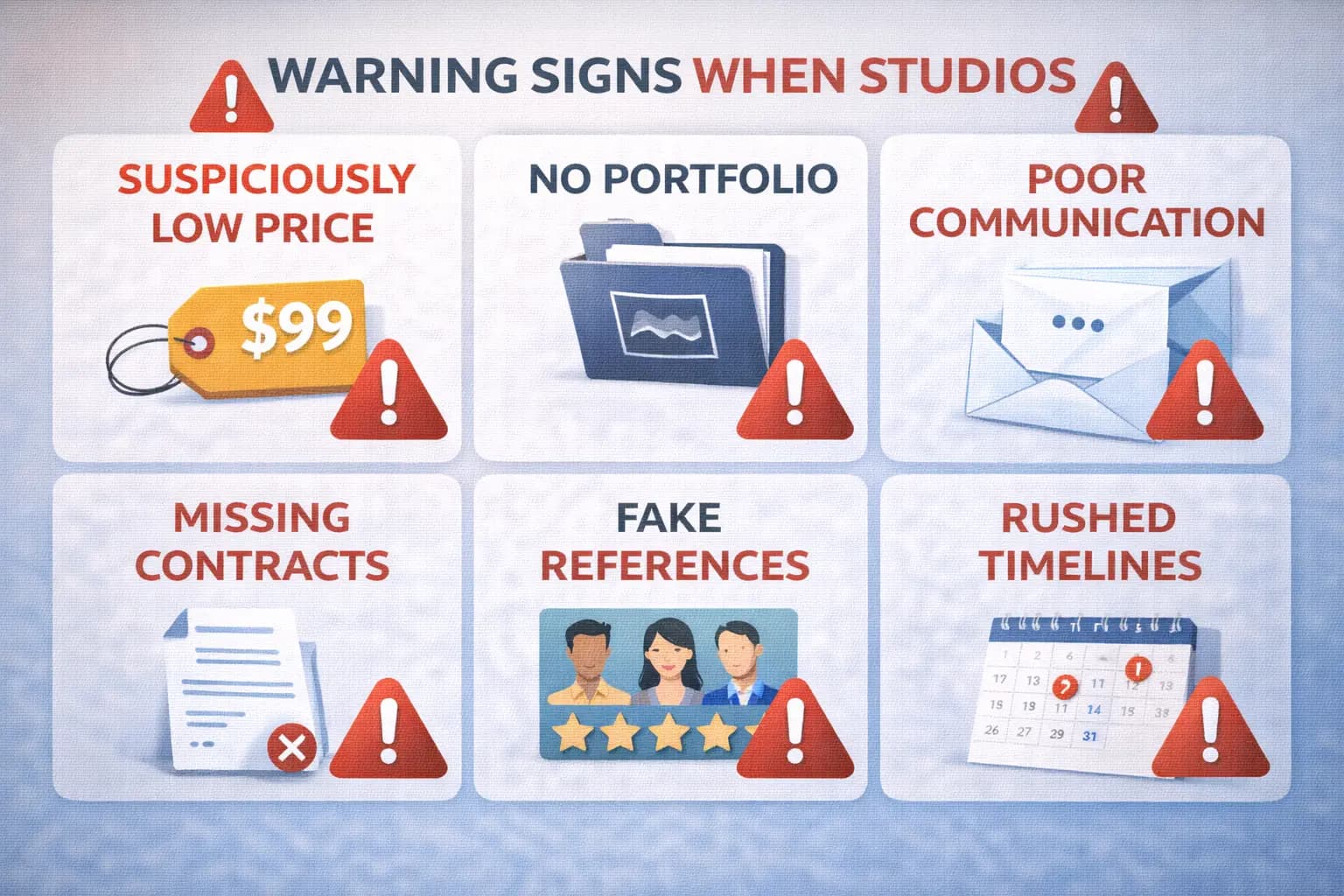
Mistake #8: Choosing Studios Without Relevant Experience in Your Project Type
A visualization studio might be excellent at luxury residential villa renderings but struggle with large commercial complexes. Another might specialize in modern architecture but lack experience with traditional Pakistani styles. This mismatch in expertise guarantees suboptimal results regardless of general competence.
Why Specialization Matters
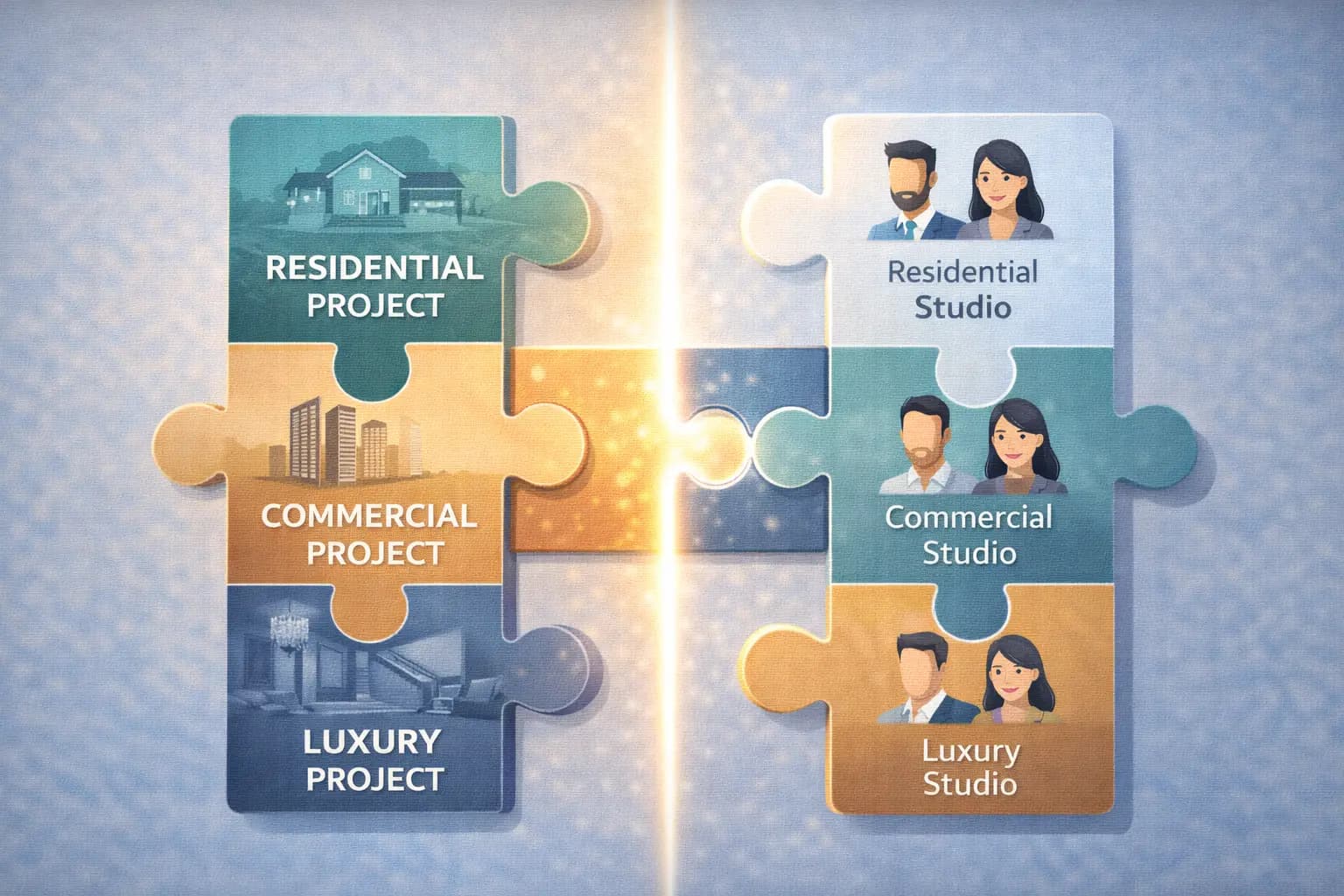
Different project types require different skillsets, aesthetic sensibilities, and technical knowledge. Residential visualization emphasizes emotional warmth, lifestyle imagery, and domestic comfort, helping buyers imagine living there. Commercial visualization highlights functionality, branding opportunities, and business suitability, convincing tenants or investors of practical value.
Luxury projects demand ultra-high-end finishes, sophisticated styling, and premium atmospheres. Middle-income housing requires relatable aesthetics without excessive opulence. High-rise developments need aerial perspectives and urban context integration. Small residential properties focus on intimate spatial qualities.
Each category has unique requirements. Studios with relevant experience understand these nuances instinctively and deliver appropriate visualization without extensive guidance.
Matching Studio Experience to Your Needs
Before hiring, analyze whether studios have demonstrated capability in your specific project type. If you're developing a luxury high-rise in Karachi's Clifton area, find studios with portfolio examples of luxury residential towers, not just single-family homes. For traditional Pakistani architectural styles, seek studios experienced with cultural design elements, not just modern minimalism.
Commercial office spaces require different treatment than retail shops or warehouses. Mixed-use developments need studios comfortable visualizing multiple program types simultaneously. Pre-construction marketing demands different skills versus completed building photography replacement.
Review portfolios specifically for relevant examples. Ask directly: "Have you worked on projects like mine before? Can you show me three to five similar examples?" Studios with appropriate experience will enthusiastically share relevant work. Those without might deflect or showcase unrelated projects.
The Learning Curve Cost
When studios lack relevant experience, they learn on your project, at your expense. Expect additional revision rounds as they figure out appropriate aesthetic approaches, longer timelines as they develop new techniques, potential quality inconsistencies compared to their portfolio strengths, and higher likelihood of missing important details specific to your project type.
Some developers intentionally hire less-experienced studios at lower costs, accepting these trade-offs. That's a legitimate choice if you understand the implications. But don't accidentally hire inexperienced partners while expecting expert-level results.
Asking the Right Experience Questions
During evaluation, probe studios' relevant background. "What percentage of your work involves projects like mine?" "Can you walk me through your experience with [specific project type]?" "What unique challenges does my project type present, and how do you address them?" "Which team members have the most relevant experience, and will they work on my project?"
Strong answers demonstrate specific knowledge and relevant portfolio depth. Weak answers reveal lack of experience despite general competence.
Balancing Specialization with Capability
While relevant experience matters, don't eliminate studios that lack exact matches but demonstrate strong core capabilities and genuine interest in your project type. A studio transitioning into new specialties might offer excellent value while building their portfolio, provided they're honest about their learning curve and adjust pricing or timelines accordingly.
The critical factor is alignment between studio strengths and your project requirements, ensuring they can deliver the specific results you need.
Contact Us Now!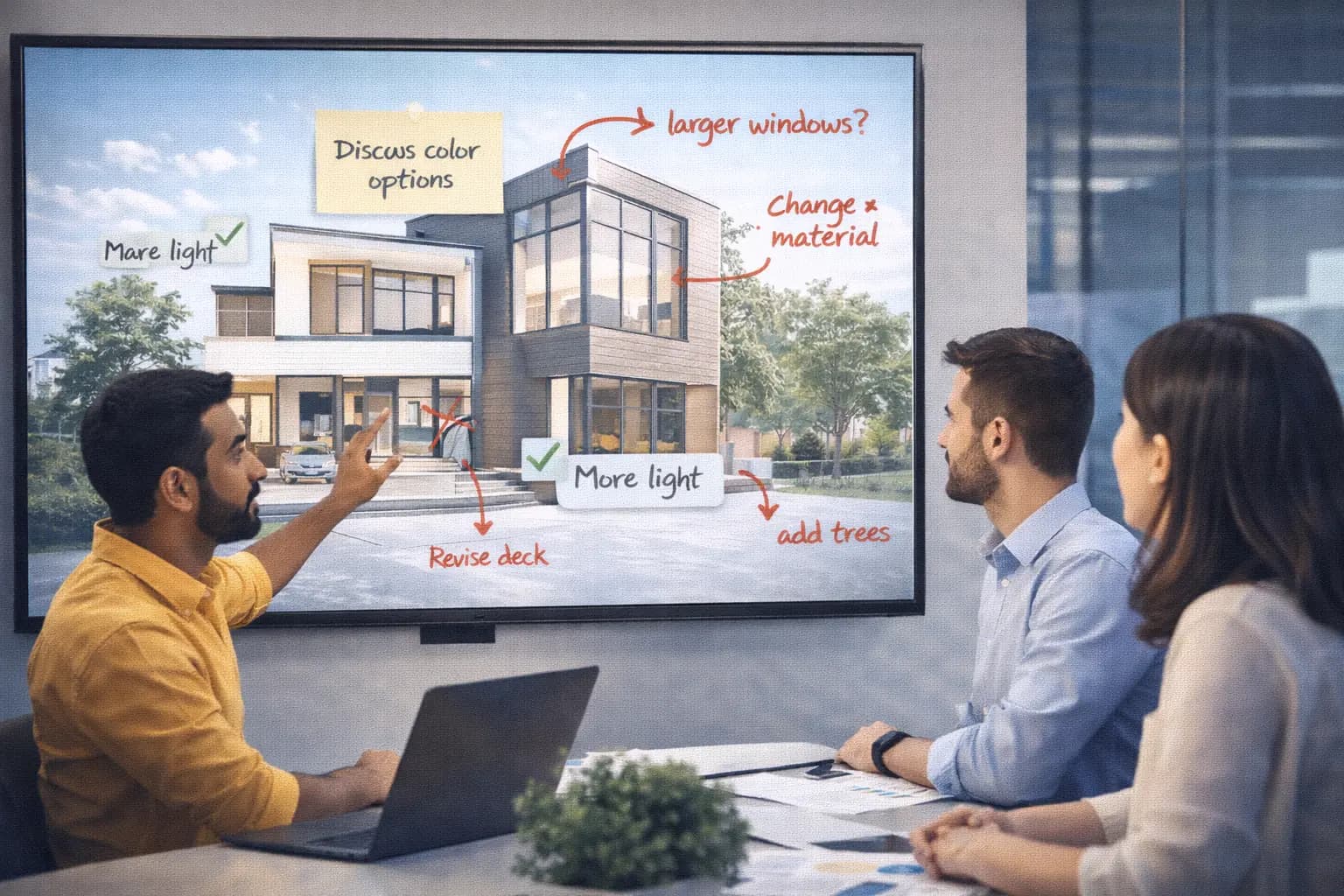
Mistake #9: Inadequate Review of Drafts and Providing Poor Feedback
Many developers passively await final deliverables without actively engaging during draft reviews. Then, upon receiving completed work, they're surprised and disappointed by results that don't match expectations. This passive approach wastes the most valuable opportunity to shape outcomes, the draft review stage.
Why Draft Reviews Matter Critically
Draft renderings are not final products, they're collaborative checkpoints where you verify the studio understands your vision and can course-correct before final production. This is when you catch misunderstandings about materials, lighting, composition, or style before artists invest hours in final refinement.
Skipping thorough draft reviews or providing inadequate feedback forces studios to guess at your preferences, dramatically increasing the likelihood of unsatisfactory final deliverables. Each missed draft review opportunity compounds problems rather than solving them.
Common Draft Review Failures
Developers make several critical errors during draft reviews. Some provide no feedback at all, assuming silence equals approval, studios interpret lack of response as satisfaction with current direction and proceed accordingly. Others give vague feedback like "make it look better" or "something feels off" without specifying what needs changing, artists cannot address problems they don't understand.
Piecemeal feedback across multiple days disrupts studio workflow and extends timelines unnecessarily. Feedback that contradicts the original brief wastes effort on misaligned directions. Most damaging is providing no feedback during drafts, then demanding extensive changes at the final delivery stage, after time and effort have been invested in wrong directions.
Effective Draft Review Process
Treat draft reviews as collaborative working sessions, not passive observations. Upon receiving drafts, block dedicated time to review thoroughly rather than glancing quickly between other tasks. Compare drafts systematically against your original brief, reference images, and project requirements. Document specific observations, what works well, what needs adjustment, and what delights you.
Organize feedback into clear categories like composition and camera angles, lighting and atmosphere, materials and textures, landscaping and environmental context, architectural accuracy and proportions, and overall mood and feel. Within each category, be specific: instead of "the lighting is wrong," say "the morning light should be warmer and softer, currently it feels like harsh midday sun."
Provide feedback in consolidated form rather than streaming thoughts over days. Studios appreciate comprehensive feedback they can address in single iterations rather than endless small adjustments.
The Feedback Quality Spectrum
High-quality feedback is specific, actionable, and grounded in the project brief. Examples of excellent feedback include "the glass facade should have more subtle reflections showing surrounding buildings, currently it looks too mirror-like," "the landscaping needs more mature trees as specified in the brief, these look like young saplings," and "the camera angle is too low, let's elevate it 10–15 degrees to better showcase the roofline design."
Poor feedback is vague, emotional, or contradictory like "I don't like it, do something different," "make it more luxurious," or "actually, let's change the entire architectural style now." The first category helps artists improve work efficiently. The second frustrates everyone and wastes time.
Managing Subjective Preferences
Some feedback involves subjective aesthetic preferences rather than objective problems. That's perfectly valid, after all, you're the client and these renderings serve your marketing goals. However, distinguish between correcting errors (the marble specified in brief is rendered as granite) and exploring preferences ("I'd like to see how travertine would look instead of marble").
Preference-based changes might count as additional revisions beyond included rounds, depending on contract terms. Be prepared for possible additional costs if you're requesting exploratory alternatives rather than corrections.
Timely Feedback Is Essential
Studios typically request feedback within three to five business days of delivering drafts. Respect these deadlines, delays on your end push back the entire project timeline. If you need more time to gather input from stakeholders or make decisions, communicate this promptly so studios can plan accordingly.
Radio silence after draft delivery creates anxiety and uncertainty on the studio side and often leads to project timeline failures.
Iteration Expectations
Understand that achieving perfection requires collaboration across typically two to three revision rounds. The first draft establishes basic composition, lighting, and style direction. After your feedback, the second iteration refines based on your input. The third polishes final details to perfection. This is a normal creative process, drafts should improve with each iteration as artist and client alignment increases. Don't panic if the first draft isn't perfect; that's why revision rounds exist.
Contact Us Now!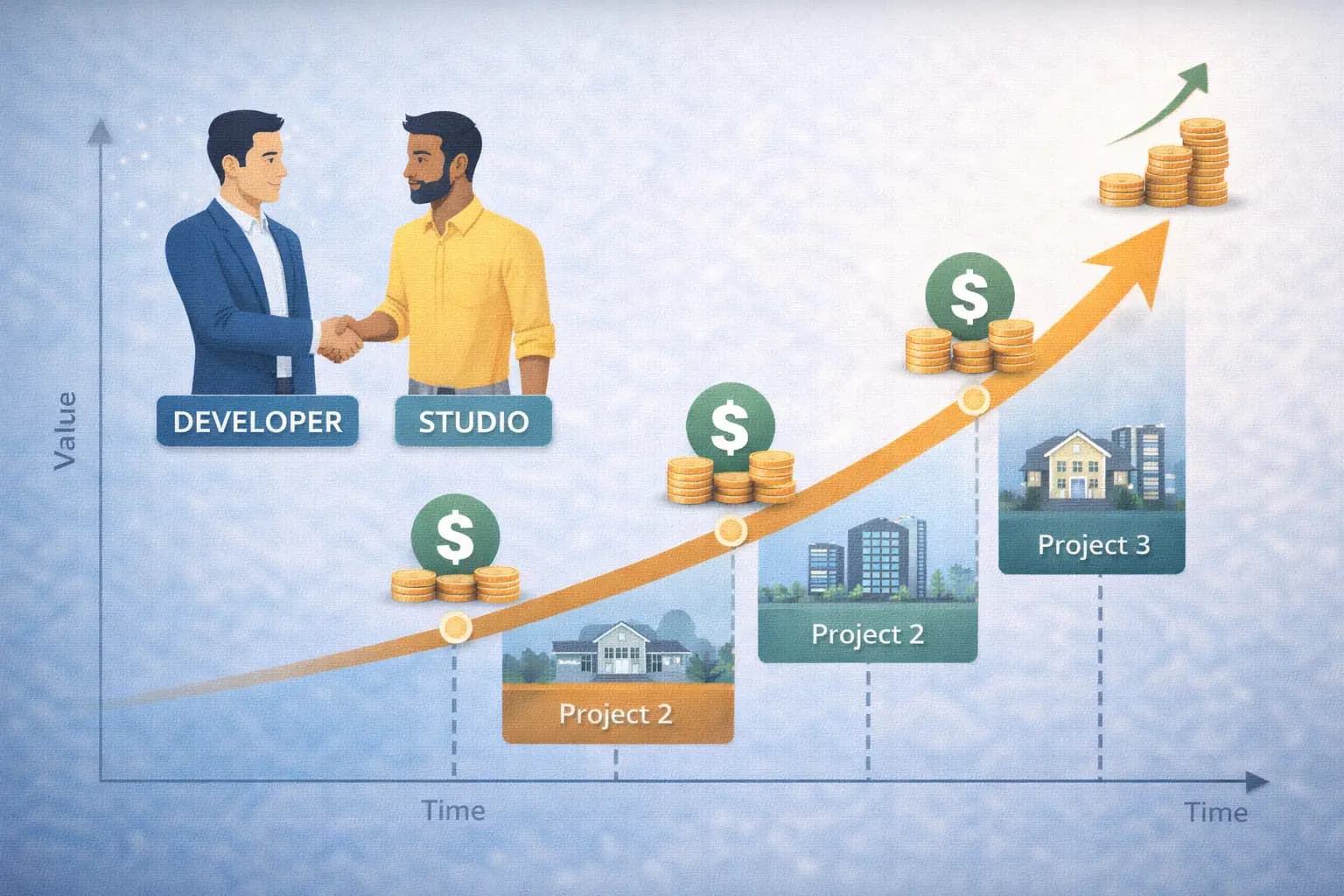
Mistake #10: Not Planning for Future Visualization Needs
Many developers treat 3D visualization as a one-time transaction for a single project rather than an ongoing strategic capability. This short-term thinking results in starting from scratch each time you need renderings, repeating vendor selection, negotiation, and onboarding processes while missing opportunities for efficiency, consistency, and cost savings that come from long-term partnerships.
The One-Off Mentality Costs
Approaching each project as an isolated engagement creates multiple disadvantages. You repeat entire studio evaluation processes for each project, spending time on portfolio reviews, reference checks, and proposal comparisons. New studios take learning curves understanding your preferences, brand standards, and quality expectations, leading to more revision rounds. Pricing remains higher without loyalty discounts or volume commitments. Visual consistency across your portfolio of projects suffers as different studios impose their aesthetic styles.
Most importantly, you miss the opportunity to build trusted partnerships that provide competitive advantages, priority scheduling during busy seasons, flexible payment terms, and deeper understanding of your business model.
Benefits of Strategic Visualization Partnerships
Developers who think long-term and build ongoing relationships with quality visualization studios enjoy substantial benefits. Efficiency improvements accelerate timelines by 20–30% as studios familiar with your preferences work faster with fewer clarifications and revisions. Cost reductions of 15–25% become available through volume discounts, loyalty pricing, and elimination of redundant startup costs. Quality consistency strengthens brand identity across all projects as the same artistic team maintains visual coherence.
Priority treatment during peak seasons ensures you're never waiting in line when urgent needs arise. Trusted partners become extensions of your team, proactively suggesting improvements, anticipating needs, and aligning with your business objectives. Financial flexibility through favorable payment terms reflects the trust built over multiple successful projects.
Building Long-Term Partnerships
After finding a visualization studio that delivers exceptional results, invest in the relationship rather than immediately seeking cheaper alternatives for your next project. Communicate that you're looking for ongoing collaboration, not just one-off transactions. Discuss volume commitments if you develop multiple projects annually. Negotiate package deals covering future work. Provide early visibility into your project pipeline so studios can plan resources and offer capacity commitments.
Offer testimonials, referrals, and case study opportunities, studios value marketing support and reputation building. Consider retainer arrangements for consistent ongoing work, ensuring dedicated capacity and predictable budgeting. Maintain regular contact even between projects, keeping relationships warm and staying updated on new capabilities.
Planning Visualization Across Project Lifecycle
Strategic developers incorporate visualization throughout project development, not just for final marketing. Early conceptual renderings inform design decisions and stakeholder presentations. Development-phase visualization supports municipal approvals and investor updates. Pre-construction marketing renderings enable pre-sales and financing. Launch-phase materials create market excitement and differentiation. Post-construction photography replacements maintain marketing consistency.
Each phase benefits from visualization, and working with the same studio across this lifecycle creates dramatic efficiencies. Studios familiar with your project from inception produce better marketing renderings because they understand the architectural evolution and design intent deeply.
Evolving Capabilities Together
As visualization technology advances with AI rendering, real-time engines, VR integration, and metaverse applications, long-term partners help you stay current without constantly evaluating new providers. Trusted studios invest in emerging tools and techniques, then guide you on appropriate adoption for your needs.
This collaborative innovation creates competitive advantages, you're leveraging cutting-edge capabilities through established relationships rather than experimenting with unknown providers.
Portfolio-Wide Visual Brand
For developers managing multiple projects simultaneously or sequentially, consistent visual branding across properties strengthens market recognition and professional reputation. When the same visualization team handles all projects, your marketing materials maintain coherent aesthetic quality and style, potential buyers begin recognizing and trusting your brand's visual presentation.
This consistency is nearly impossible to achieve by constantly switching visualization partners, each with different artistic approaches and quality standards.
When to Maintain Multiple Studio Relationships
While primary partnerships offer significant benefits, maintaining relationships with two to three quality studios provides useful backup and specialization options. Perhaps your primary partner excels at residential work while a secondary studio specializes in commercial visualization. Or you maintain alternatives for capacity overflow during busy periods.
The key is strategic diversification rather than random vendor switching. Build a trusted network rather than repeatedly starting from scratch.
Contact Us Now!Conclusion: Avoiding Mistakes, Ensuring Success
Hiring the right 3D visualization studio determines whether your investment delivers exceptional ROI or disappointing waste. The ten critical mistakes we've explored, choosing based solely on price, skipping thorough portfolio reviews, providing incomplete project briefs, ignoring communication quality, neglecting reference checks, demanding unrealistic timelines, proceeding without clear contracts, hiring studios lacking relevant experience, inadequate draft review engagement, and failing to plan for long-term needs, account for the vast majority of failed visualization partnerships.
Each mistake is entirely preventable through diligent evaluation, clear communication, and strategic thinking. The consequences of avoiding these pitfalls extend far beyond just receiving nice renderings. You accelerate project timelines through efficient collaboration, maximize ROI through appropriate investment in quality, build competitive advantages via superior marketing materials, strengthen your brand through consistent professional presentation, reduce stress through reliable partnerships, and enable sales success with visualization that genuinely connects with buyers.
The Pakistan real estate market in 2025 is more competitive than ever, Karachi's luxury developments compete globally for overseas investors, Lahore's mixed-use projects fight for domestic buyers' limited budgets, and Islamabad's emerging smart cities attract sophisticated purchasers with high expectations. In this environment, subpar visualization is a luxury no developer can afford.
Your visualization partner becomes an extension of your brand, an amplifier of your architectural vision, and a catalyst for your sales success. Choose wisely. Evaluate thoroughly. Communicate clearly. Build strategically. The returns, faster sales, higher prices, stronger brand equity, and competitive differentiation, far exceed the effort invested in making smart hiring decisions.
Remember: the goal isn't finding the cheapest studio or even the most expensive one. The goal is finding the right partner whose capabilities, experience, communication style, and approach align perfectly with your needs and deliver measurable results that transform your real estate success.
Ready to make your next visualization project your most successful yet? Apply these insights, avoid the common mistakes, and watch as professional visualization elevates your projects from concepts to sold-out successes.
Offer testimonials, referrals, and case study opportunities, studios value marketing support and reputation building. Consider retainer arrangements for consistent ongoing work, ensuring dedicated capacity and predictable budgeting. Maintain regular contact even between projects, keeping relationships warm and staying updated on new capabilities.
Get a QuoteFrequently Asked Questions
How can I verify if a studio's portfolio samples are actually their own work?
Request detailed background on portfolio pieces including project names, client names (permission allowing), team members who worked on specific renderings, timeline and budget for highlighted projects, and original file metadata. Conduct reverse image searches on portfolio samples to check if they appear elsewhere online. Ask for work-in-progress files showing modeling stages, draft renders, and revision history, studios showcasing stolen work cannot provide these. Request client references for impressive portfolio pieces and verify directly. Legitimate studios welcome verification and understand the importance of authenticity.
What should I do if a studio delivers poor-quality work despite good portfolios?
First, review your contract to understand deliverable specifications and revision rights. Provide specific, detailed feedback on quality issues referencing your original brief and portfolio examples that attracted you. Request explanations for the quality gap and concrete plans for improvement. If the studio is cooperative, allow revision opportunities as contracted. Document all communications in writing. If revisions don't achieve acceptable quality, withhold final payment and cite specific contract breaches. Consider mediation or small claims processes if necessary. For future projects, include quality benchmarks in contracts with specific portfolio examples as minimum acceptable standards.
How do I know if I'm being unreasonable with timeline demands?
Compare your timeline expectations against industry standards, static renders typically require five to seven days, virtual tours two to three weeks, animations three to six weeks. Consider project complexity honestly, intricate architectural designs, detailed environments, and multiple deliverables extend reasonable timelines. Ask studios directly if requested timelines are achievable without quality compromises. Be willing to pay appropriate rush fees (30–50% premium) for truly urgent needs. If multiple studios tell you timelines are unrealistic, listen, it's likely true. Plan visualization needs into your overall project schedule rather than treating them as last-minute additions.
What's a fair deposit amount when contracting a new visualization studio?
Standard industry practice is 30–50% deposits upon contract signing, with this upfront payment securing studio commitment, covering initial modeling and setup work, and demonstrating your serious intent. Deposits of 50% or more might be acceptable for smaller total projects, while large-scale projects often use 30–40% deposits. Avoid studios demanding 100% payment before delivering any work, that's a significant red flag indicating potential fraud or cash flow desperation. Conversely, studios requiring no deposit may lack professionalism or adequate business processes. Structure payments as milestones, deposit at start, mid-project payment at draft delivery, final payment upon completion.
Should I hire different studios for different aspects of my project?
This depends on project complexity and studio capabilities. For most projects, a single comprehensive studio handling all visualization needs creates better visual consistency, simplified project management, potential package pricing discounts, and clearer accountability. However, specialized large-scale projects might benefit from multiple studios if one excels at architectural rendering while another specializes in interior design visualization, or if one handles static images while another creates animation and virtual tours. The coordination complexity and potential visual inconsistency often outweigh benefits unless you have strong project management capabilities. Start with one trusted studio and add specialized partners only when clear gaps exist.
How can I tell if revision requests are reasonable or excessive?
Reasonable revisions correct errors or adjust elements to match your original brief, fixing architectural inaccuracies, adjusting materials to specified selections, refining lighting to requested scenarios, and correcting composition issues. Excessive revisions change fundamental design directions not in the original brief, completely different architectural styles, new camera angles beyond original scope, adding elements never mentioned initially, and exploring alternatives beyond decision-making needs. Check your contract revision policy and compare requests against it. If you're frequently hitting revision limits, either your brief was inadequate initially or you're requesting changes beyond reasonable scope. Communicate openly with studios about what constitutes normal refinement versus new work requiring additional fees.
What recourse do I have if a studio misses contracted deadlines?
Review contract terms for deadline clauses and consequences of delays. Document the delay formally in writing, requesting explanation and revised delivery schedule. Assess whether delays resulted from studio failures (poor planning, overcommitment, technical problems) or your actions (late brief, slow feedback, scope changes). If the studio is at fault, reference contract terms and request compensation, expedited delivery, partial refunds, or additional deliverables. For severe delays jeopardizing your project launch or obligations, consider contract termination clauses and seek alternative studios, though be prepared for potential quality inconsistency. For future contracts, include specific delay penalties and performance guarantees.
How should I handle disagreements about whether my feedback constitutes a new scope or revision?
Prevent disputes through detailed contracts clearly defining revision scope, specify that adjustments to elements within the original brief (colors, materials, minor composition tweaks) are included revisions, while additions or fundamental changes beyond the brief require new proposals. When disagreements arise, reference your original brief and mutual agreement documents. Ask the studio to explain specifically why they view your request as out of scope. Consider their perspective objectively, is your request genuinely within original parameters or evolving your vision? Compromise when appropriate, perhaps splitting the difference in costs or agreeing to limited exploration within the current revision round. For valuable long-term relationships, occasional flexibility builds goodwill that benefits future projects. Document resolution clearly to prevent repeated disagreements.
Can I request ownership of 3D models and source files, and what's fair pricing?
Yes, you can request source file ownership, it's negotiable like any contract term. Studios typically retain source file intellectual property in standard agreements because these files represent significant time investment and proprietary techniques. Purchasing source files usually adds 30–50% to base project costs, reflecting their potential future usefulness and studio investment. Before requesting ownership, clarify why you need source files, will you genuinely create additional renderings using them, or is this theoretical? Many developers find rendered images sufficient for all practical needs. If you do need source files, negotiate upfront rather than requesting after project completion when leverage is minimal. Consider limited licensing instead of full ownership, rights to create additional renders without full file transfer might meet your needs at lower costs.
What should I look for in contracts regarding intellectual property and usage rights?
Ensure contracts clearly specify that you receive unlimited usage rights for final rendered images for your project's marketing, advertising, sales, and promotional purposes across all media, print, digital, outdoor advertising. Clarify whether you can use renderings for purposes beyond this specific project if relevant. Understand that studios typically retain rights to showcase work in their portfolios unless you negotiate confidentiality restrictions. Confirm ownership of underlying 3D models, scene files, and source materials, typically these remain studio property unless separately purchased. Address whether you can modify delivered images using your own resources or must request studio changes. Include provisions preventing studios from creating similar renderings for your competitors. Specify how long studios must maintain project files in case future modifications are needed. Clear intellectual property terms prevent disputes and ensure you can use visualization assets as needed throughout the project lifecycle.
Latest Blogs
View All Blogs →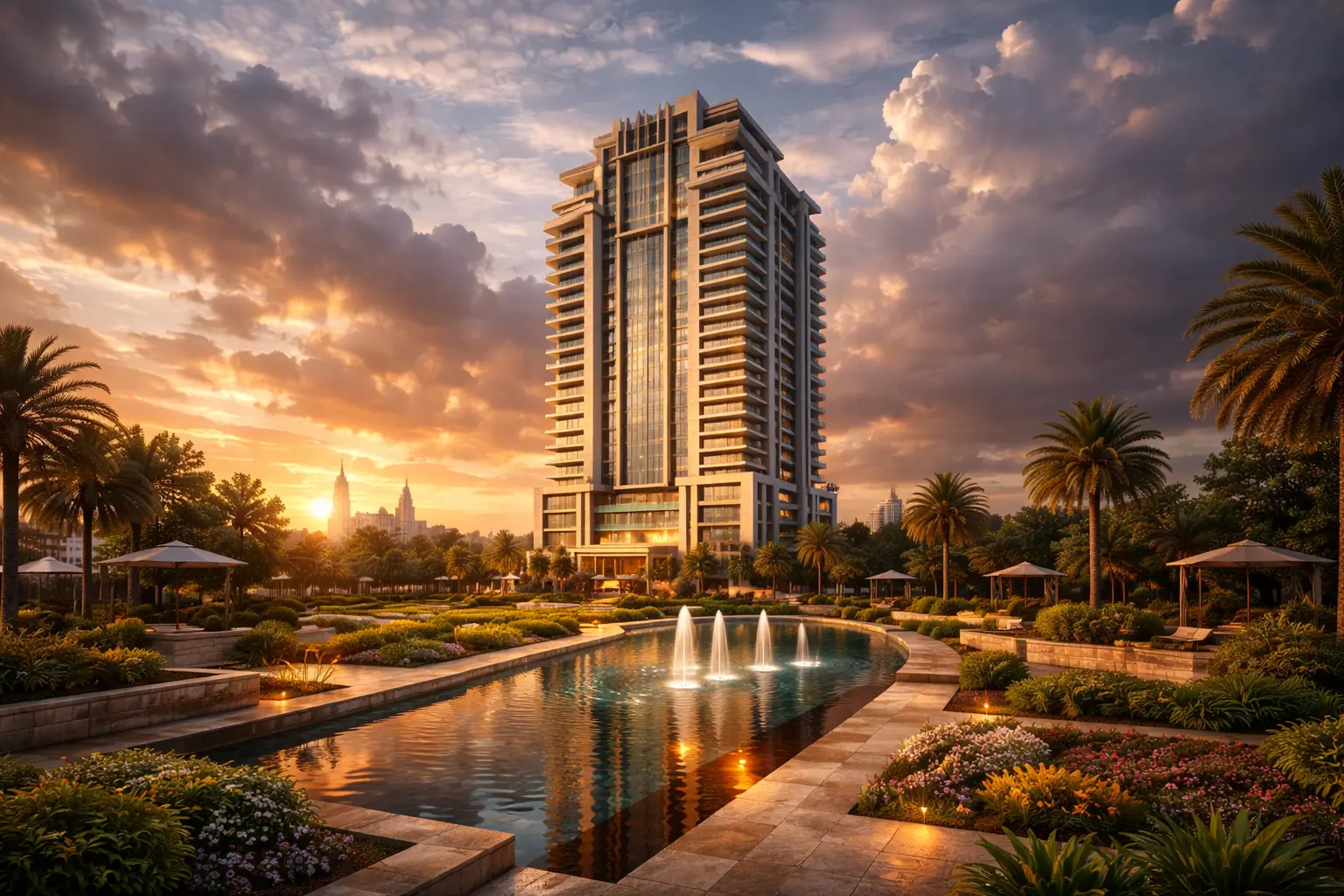
How 3D Visualization Boosts Off-Plan Property Sales by 31%
Data-backed guide on how interactive 3D property visualization helps real estate developers worldwide sell off-plan units faster, at higher prices.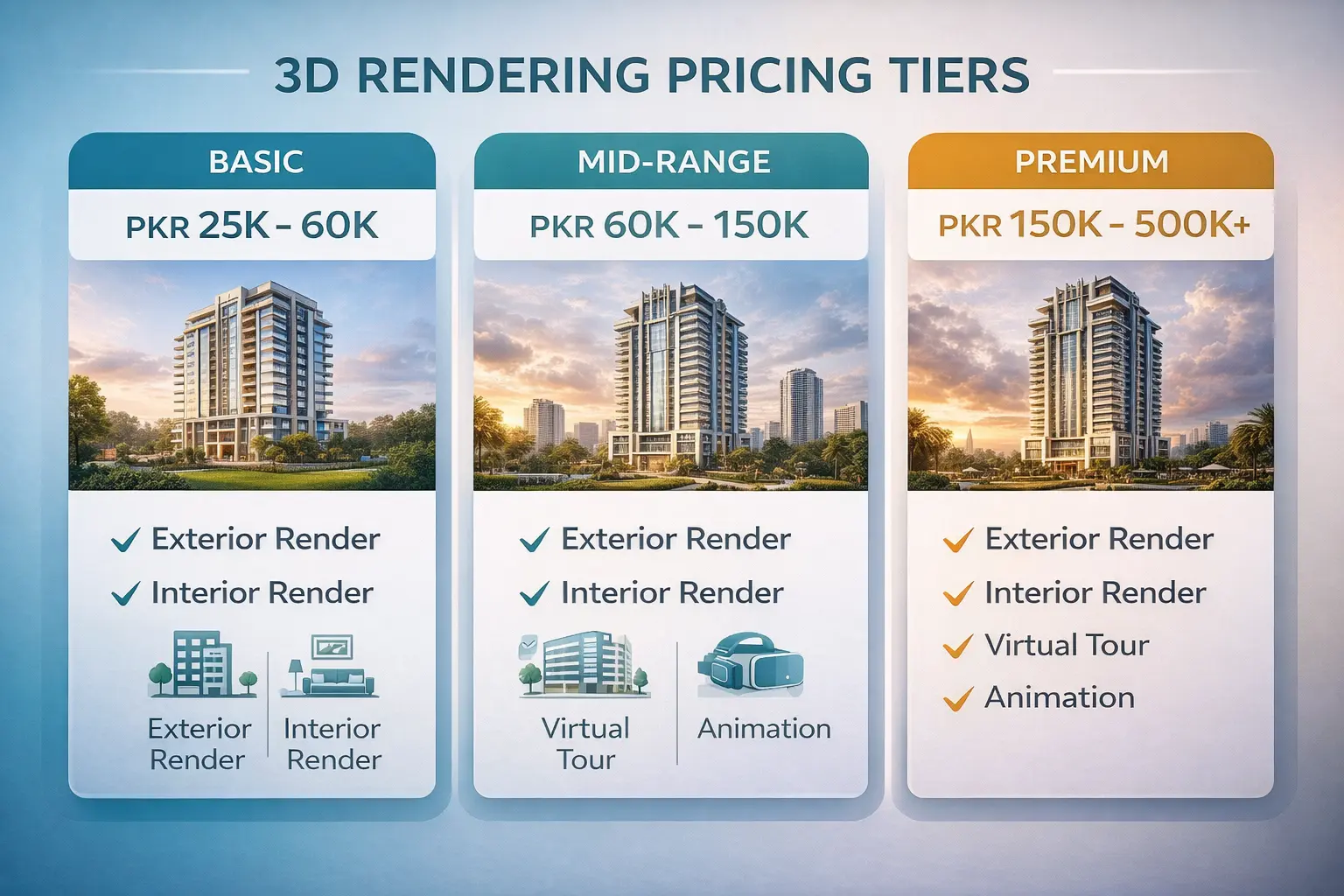
How Much Does 3D Rendering Cost in Pakistan? Pricing Guide
Complete 3D rendering cost guide Pakistan 2025. Real rates: PKR 15K-250K per image. Budget planning, pricing models, hidden fees, ROI tips for developers.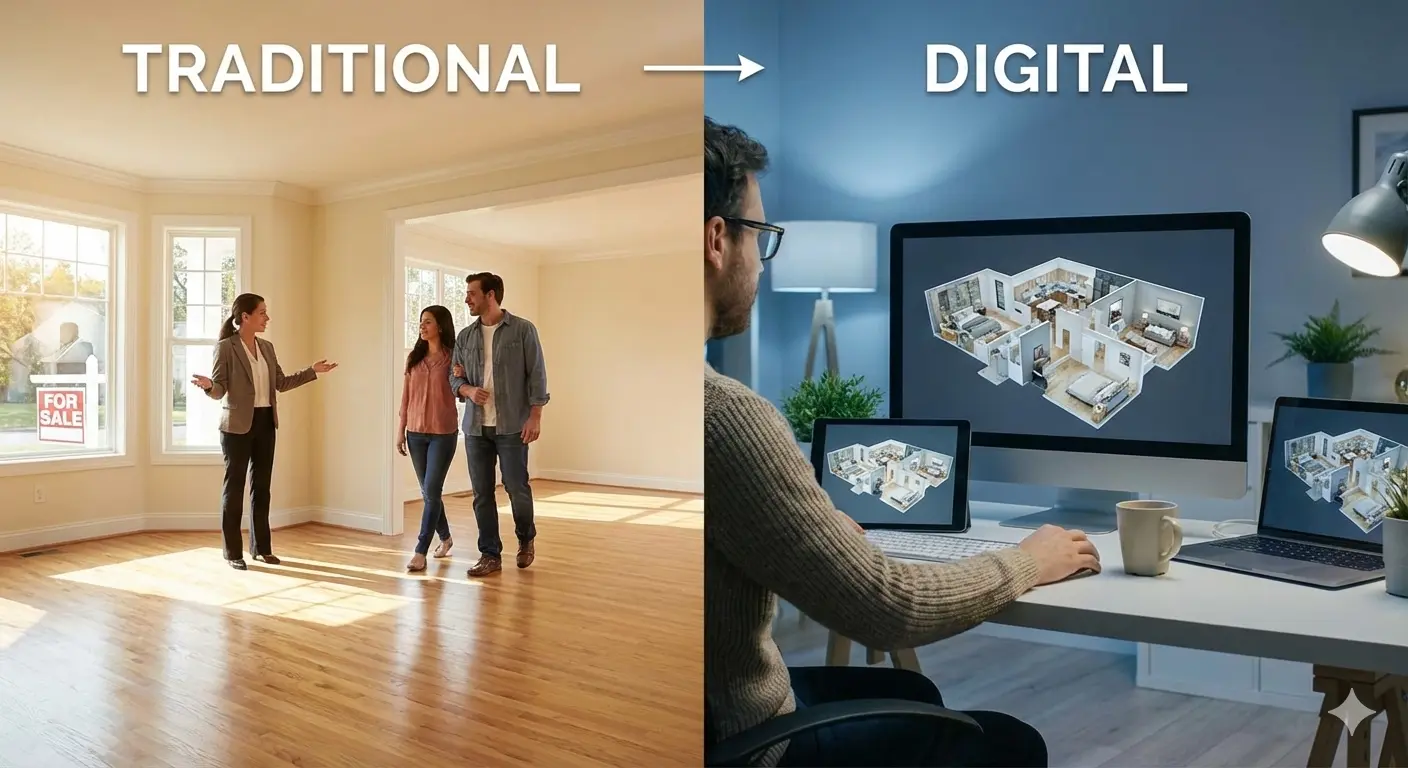
Virtual Tours vs Physical Visits: Why Developers Go Digital
Why 40% of real estate developers are switching to virtual 3D property tours — ROI analysis, buyer engagement data, and hybrid strategy guide.Developer & Investor Insights
Practical guidance for real estate developers worldwide on using interactive 3D visualization to sell off-plan properties faster and more effectively.
3D & Visualization Strategies
How architectural renders, interactive 3D walkthroughs, and virtual property tours influence buyer decisions in the global off-plan market.
Real Estate Sales Intelligence
Data-driven insights on buyer behavior, off-plan pricing psychology, and digital sales strategies for real estate developers worldwide.
